Back to List
November 2026
When choosing roller shades, it's easy to focus on what you can see: color, texture, how much sunlight the shade blocks and how clearly you can see outside. But there's another important factor you may never see at all: the material at the core of the fabric.
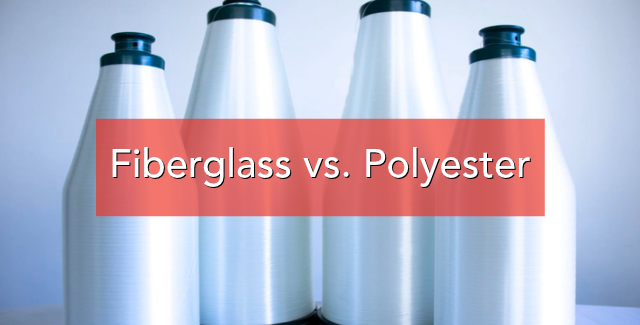
Fiberglass and polyester are two materials commonly used inside solar shade fabrics. While their final fabrics may look and feel similar, their physical properties of the core can influence how a shade hangs, how clearly you see through it and how well it performs over time.
What is at the Core of a Roller Shade Fabric?
Many solar shade fabrics are woven from yarns made with an inner core surrounded by a protective coating. Think of the core as the skeleton of the fabric. It provides structure, while the coating adds characteristics such as color and durability.
Fiberglass begins with naturally occurring materials, primarily silica sand, which are melted and drawn into fine glass filaments. Polyester, on the other hand, is a synthetic material made from polymers.
Both can be used to create vinyl-coated solar shade fabrics, but they behave differently. Polyester is flexible and can stretch under tension, while fiberglass is strong, dimensionally stable and highly resistant to heat.
For roller shades, those differences matter.
Why Fiberglass Holds Its Shape
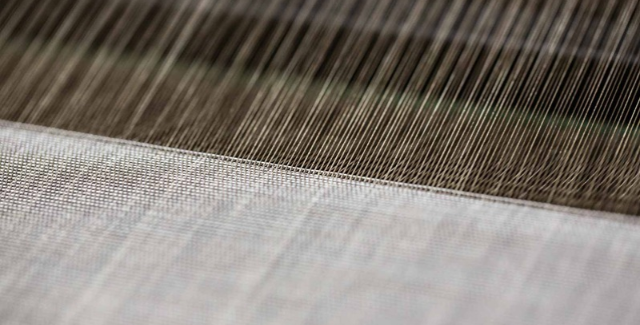
One of fiberglass's biggest advantages is dimensional stability, or the ability to maintain its original shape.
Roller shades are exposed to sunlight, heat, gravity and repeated movement. Over time, those conditions can cause some fabrics to stretch, wrinkle or lose their shape, affecting how the shade hangs and rolls.
Fiberglass has extremely low elongation, meaning it resists stretching even under tension.
In comparative testing, fiberglass and polyester shade fabrics were placed under tension and exposed to 140°F heat. After six hours, the fiberglass fabric stretched less than 1%, while the polyester fabric stretched approximately 4%.
That difference helps explain why fiberglass is particularly well suited to roller shades. Its stability helps the fabric hang straighter, maintain its shape and track consistently, especially in larger windows and motorized applications.
How Fiberglass Creates a Clearer View
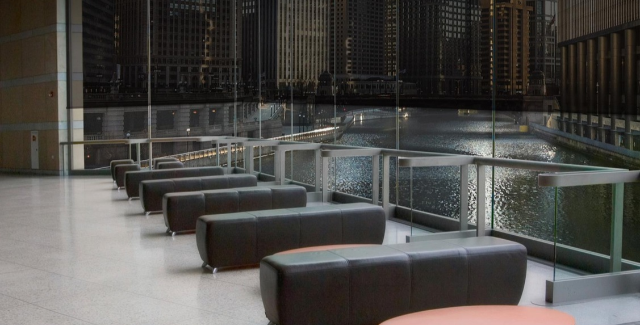
Solar shade fabrics are designed to control sunlight and glare while preserving your view outside.
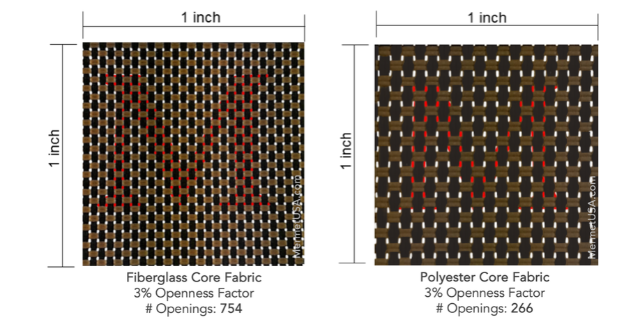
You may have seen fabrics labeled with an openness factor, such as 1%, 3% or 5%. This number represents the percentage of open area in the fabric. But two fabrics with the same openness factor don't necessarily provide the same view.
Yarn size and weave construction also matter.
Think of it like the resolution of a screen. Finer detail can create a sharper, clearer image. Fiberglass’s material strength allows for thinner yarns that contribute to a more refined view through the fabric.
In comparative testing, fiberglass and polyester fabrics with nearly identical openness factors had approximately 750 and 520 openings per square inch, respectively. A higher number of openings correlates to finer detail. The finer fiberglass construction contributes to a crisper view.
Openness tells you how open the fabric is. Its construction helps determine how clearly you experience the view.
Why Weight, Thickness and Heat Matter
Fabric weight and thickness affect more than appearance. Every time a roller shade moves, its operating system must manage the weight and bulk of the fabric.
Fiberglass core fabrics can be thinner and lighter than comparable polyester constructions. A thinner fabric creates a smaller roll-up diameter, and less weight can reduce the load on motors and hardware. These advantages become especially important for large or motorized shades.
Fiberglass also has a melting point approximately three times higher than polyester, giving fiberglass core fabrics greater resistance to elevated temperatures.
That matters at a window, where sunlight can generate significant heat. Fiberglass's resistance to heat and stretching helps the fabric maintain its shape under demanding conditions.
Regarding fire performance, fiberglass itself inherently resists burning and passively contributes to fire standards. However, keep in mind that the fire performance of a finished fabric depends on its complete construction and testing, not simply its core material.
Is Fiberglass or Polyester Better for Roller Shades?
Both materials have advantages depending on the application. Polyester's flexibility and resistance to tearing make it useful for products that need to stretch or bend. Fiberglass offers characteristics particularly valuable in roller shades, where maintaining shape, preserving views and supporting reliable operation are priorities.
When choosing roller shade fabric, look beyond color and openness. Consider the core material, yarn construction, fabric weight and how the shade will be used.
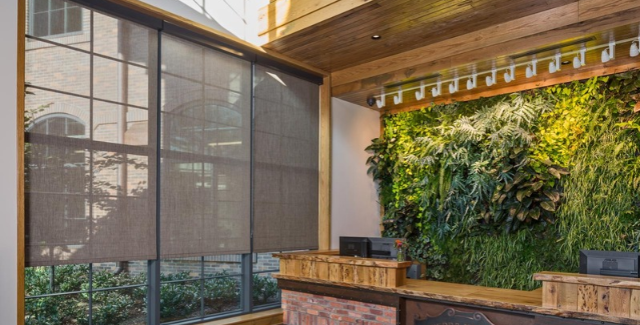
At Mermet, fiberglass is a deliberate material choice. Our vinyl-coated fiberglass fabrics combine a strong, fine fiberglass core with a durable protective coating to create solar shade textiles engineered for both the view through the window and the long-term performance of the shade.
Color may be what you notice first, but performance starts at the core.
Explore Why Fiberglass to learn more about how Mermet turns the properties of fiberglass into real-world roller shade performance.